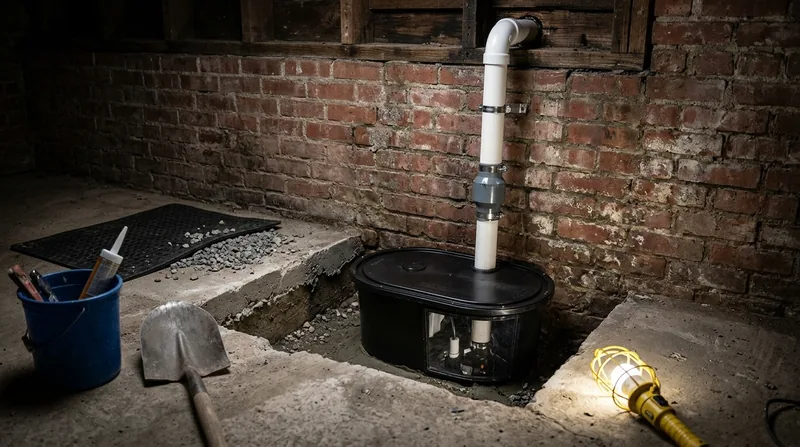




Washington sits on the fall line where Piedmont schist and clay meet the Atlantic Coastal Plain, and that geology decides how water behaves under your house. In Capitol Hill and Georgetown, 1880s brick rowhouses with English basements sit on old brick or rubble-stone footings that never had a modern footing drain. In Bloomingdale and LeDroit Park, buried streams and high groundwater push against basement walls during summer cloudbursts, and the flash flooding there is not a rumor. A properly sized Sump Pump Installation & Replacement in Washington is the difference between a damp cellar and a finished basement you can actually use. We install sealed sump basins, correctly sized pumps, check valves, and discharge lines that carry water far enough from the foundation to keep up with a DC downpour without burning out the motor. If your current pump short-cycles, runs constantly after rain, or has gone silent, call us at (771) 240-2593 before the next storm finds the low spot. Start with a free basement inspection so we can see what the water is actually doing.
Why Sump Pump Failure Hits Washington Basements Harder Than Most
The building stock here was never designed for the water loads it now carries. Clay soil in Petworth and Columbia Heights holds rainfall like a sponge and releases it slowly against foundation walls, while hillside runoff in Cleveland Park and Takoma Park sheets down against downhill walls. When a pump quits during a storm, the sump basin fills in minutes, not hours, and the water finds every cold joint and mortar course in an 1890s foundation.
- Heavy clay and glacial soil slow drainage, so hydrostatic pressure stays high for days after a storm.
- Buried streams and springs in Bloomingdale and LeDroit Park raise the water table fast during summer downpours.
- Old brick and rubble-stone foundations in Georgetown and Brookland wick water laterally into the basement.
- Freeze-thaw winters crack discharge lines that were not pitched or insulated correctly.
- Remnant tropical storms dump several inches in hours, which overwhelms undersized pumps and shallow basins.
Every one of those failure modes points back to the same fix: a pump and basin sized for the actual water volume, not the cheapest unit on the shelf.
Key info: A pump that runs nonstop after a storm in Bloomingdale is usually undersized or fighting a clogged discharge line, not just old. We see this most on 1920s brick rowhouses where the original sump pit is only 18 inches deep and fills faster than a 1/3 HP pump can move it.
For official guidance on drainage and discharge connections, check the DC Department of Buildings before any work that alters how water leaves the property.
How We Install and Replace a Sump Pump in a Washington Rowhouse
We do not drop a pump into whatever hole is already there and call it done. On a Capitol Hill or Petworth rowhouse, the sump basin has to be set into the lowest corner of the basement floor, tied into the interior perimeter drain if one exists, and sealed so soil gas and water do not bypass it. We check the discharge route first, because a pump that dumps water three feet from the foundation just sends it back through the wall.
- We inspect the basement, the existing sump basin, and the exterior grade to find where water is entering.
- We size the pump to the water volume and head height, not to a generic 1/3 HP default.
- We set a sealed basin and connect it to the drain tile or interior perimeter drain where present.
- We install a check valve and route the discharge line to a frost-free, positively pitched outlet away from the house.
- We test the pump under load and confirm the float switches and backup power work before we leave.
If the basement already has a failing drain tile system feeding the sump, we address that at the same time so the new pump is not fighting a broken collector.
Key info: On a 1940s brick Colonial in Arlington, the old discharge line ran uphill to a downspout and froze every January. We re-routed it to a gravity outlet through the rim and added a battery backup sump pump so a power outage during a summer storm would not flood the finished side of the basement.
When the water problem is bigger than the pump itself, an interior drain tile system is often the better answer than replacing the pump alone.
Sump Pump Approaches We Use Across the DC Metro
No two basements here take the same setup. A 1960s split-level in Hyattsville with a partly finished basement needs a different pump and basin than a poured walkout in Bowie, and a Georgetown cellar with a rubble-stone floor needs a basin set carefully to avoid undermining the footing. The table below shows the main approaches and where each one fits.
| Approach | Description | Best for |
|---|---|---|
| New sump basin and pump | We cut and set a sealed basin in the low corner, size the pump to the water load, and tie it to the drain tile. | Basements with no sump, or a shallow pit that overflows |
| Pump replacement only | We swap a failed or undersized pump, reuse a sound basin, and add a check valve if missing. | A working basin with a burned-out or short-cycling pump |
| Discharge line correction | We re-pitch and re-route the line to a frost-free outlet that carries water well away from the foundation. | Pumps that cycle constantly or lines that freeze and back up |
| Battery backup addition | We add a backup pump and battery so the basin keeps emptying during a power outage. | Finished basements and homes that lose power in storms |
| Sump tied to interior drain tile | We connect a new basin to the perimeter drain so wall seepage reaches the pump instead of the floor. | Basements with hydrostatic pressure and wet walls after rain |
We pick the approach after we see the basement, because a pump that is right for a Bowie walkout is wrong for a Georgetown cellar.
Sump Pump Installation & Replacement Cost in Washington: What to Expect
Most homeowners want a number before they want a lecture, so here is the honest range. A straightforward pump replacement in an existing sound basin starts around $1,200, and a full new basin, pump, check valve, and discharge line runs higher depending on how much floor has to be opened and where the water can legally go. The variables that move the price most are basin depth, whether the discharge can gravity-feed or needs a lift, whether the sump ties into an existing drain tile, and how hard it is to get equipment into a finished or tight basement.
Old rowhouses in Capitol Hill often cost more than a 1990s Bowie subdivision because the floor is brick or stone, the ceiling height is low, and the discharge route is tight. Getting two or three estimates is smart, not because the cheapest is wrong, but because you want to hear the same diagnosis twice. A contractor who quotes a pump without looking at the discharge line or the water table is guessing. Our full pricing overview breaks down the line items so you can compare apples to apples.
Finding a Sump Pump Contractor Near Me in Washington: What to Check
Hiring for below-grade work is different from hiring a plumber or a general handyman. You want a contractor who works on foundations and drainage every week, carries liability and workers comp, and will put the scope in writing. Ask for the license and insurance certificate before work starts, and call the references on jobs similar to yours, not just the easy ones.
- Confirm the contractor is licensed and insured for foundation and drainage work in the District.
- Get two or three written estimates that list the pump model, basin size, and discharge route.
- Ask whether a permit is required for the discharge connection in your jurisdiction and who pulls it.
- Check references from rowhouse or older-home jobs, since those are the hard ones.
- Ask how they handle the discharge outlet so water does not run back to the foundation or onto a neighbor.
If a contractor cannot answer those questions plainly, keep looking. You can reach us through our contact page to schedule an inspection and get a written scope.
Sump Pump Installation & Replacement in Washington: Pricing Guide
| Service | Price | Details |
|---|---|---|
| Pump replacement in existing basin | Starting at $1,200 | Includes new pump, check valve, and load test; price rises with pump capacity and discharge length. |
| New sump basin and pump | Starting at $1,850 | Includes cutting and sealing a new basin, pump, check valve, and discharge line; floor material moves the price. |
| Sump tied to interior drain tile | On estimate | Requires an on-site look at the perimeter drain condition, basement layout, and discharge route before pricing. |
| Battery backup addition | Starting at $650 | Includes backup pump, battery, and wiring; battery capacity and existing pump setup affect the final figure. |
| Travel | Included | In Washington and surrounding areas, no separate call-out or mileage fee. |
| Estimate | Free | Response within 24h at (771) 240-2593, no obligation to book. |
Indicative pricing, the exact cost depends on square footage, finish, and site access. Free personalized estimate within 24h at (771) 240-2593.


