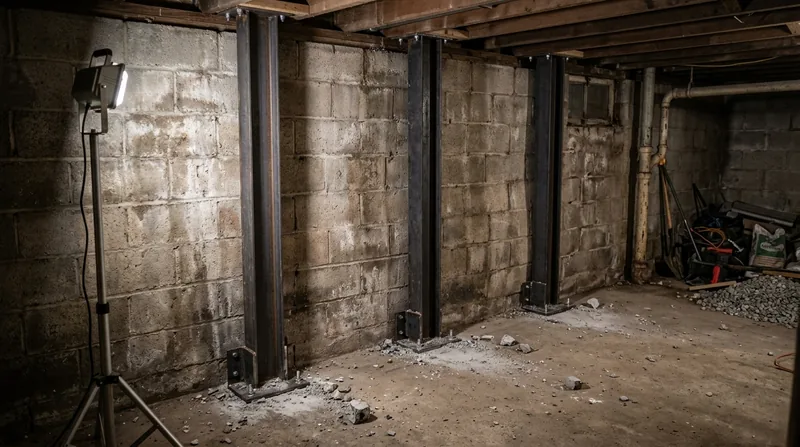




Washington sits right on the fall line, where Piedmont schist and clay meet the Atlantic Coastal Plain, and that geology puts real lateral pressure on basement walls. In Capitol Hill, Georgetown, and Petworth, 1880s to 1920s brick rowhouses sit on old brick or rubble-stone foundations that were never designed for today's saturated clay loads. Out in Cleveland Park, Takoma Park, and Arlington, 1920s to 1940s Tudors and Colonials have deep basements with block or brick walls that bow inward when hydrostatic pressure builds season after season. Bowing Wall Repair in Washington means reading the movement correctly: is the wall rotating, bulging at mid-height, or cracking at the corners, and what soil and water table conditions are driving it. We stabilize leaning and bowing walls with carbon fiber straps, steel I-beams, or wall anchors matched to severity, then address the water causing the pressure. Start with a free basement inspection so we can measure the movement before anything gets specified.
Why Bowing Walls Are a Washington Problem, Not Just an Old-House Quirk
The dominant failure mode here is saturated glacial clay pressing against older masonry. Heavy summer downpours, remnant tropical storms, and freeze-thaw winters push the water table up along the Potomac, Anacostia, and Rock Creek low spots, and that water does not drain through clay quickly. Add hillside runoff against downhill walls in places like Mount Rainier and Takoma Park, and a brick wall that has stood for a century starts to move. Flash flooding has hit Bloomingdale and LeDroit Park repeatedly, and every event loads those foundation walls again.
- Horizontal cracking at mid-height of a block or brick wall usually signals lateral pressure, not settlement.
- Inward bowing of more than about an inch over the wall height needs stabilization, not just patching.
- Stair-step cracking near corners often tracks movement at the footing where clay holds water.
- Efflorescence and white staining show moisture is moving through the masonry and depositing salts.
- Sticking doors and windows above the wall can indicate the wall plane is changing.
If you see any of these, the wall is telling you the soil is winning and the repair needs to address both the structure and the water.
Key info: In a Petworth rowhouse we inspected last spring, the rear brick wall had bowed roughly 1.5 inches over eight feet, with horizontal cracking and heavy efflorescence. The cause was a blocked footing drain and clay soil holding water against the wall. The fix was carbon fiber straps plus an interior perimeter drain to relieve the pressure, not exterior excavation.
For official guidance on structural permits and inspection requirements in the District, check the DC Department of Buildings before any structural foundation work begins.
How We Diagnose and Stabilize a Bowing Wall in Washington
We do not quote a repair from a photo. We measure the wall, check plumb and level, map the cracks, and look at the water source. In 1950s and 1960s brick ranches across Bethesda, Wheaton, and Hyattsville, the movement is often a slow bulge from clay pressure; in 1980s to 2010s walkout basements in Bowie and Fairfax, it is more often a corner crack tied to grading and downspout discharge. The method follows the diagnosis.
- We inspect the interior wall face, the footing area, and the exterior grade to find where water is loading the wall.
- We measure the amount of bow and the wall height to classify the movement as monitor, stabilize, or structural repair.
- We relieve the water pressure with an interior drain tile system or exterior drainage as the site allows.
- We install carbon fiber straps, steel I-beams, or wall anchors to stop further movement and stabilize the wall.
- We seal cracks and finish the wall surface so the repair is clean and the basement stays usable.
The order matters: stabilizing a wall without relieving the water pressure just delays the next problem.
Key info: A 1920s brick Colonial in Cleveland Park had a bowing front wall and a wet basement after every heavy rain. We installed steel I-beams on the interior face and tied the wall to the footing, then added an interior perimeter drain and a sump basin with a check valve. The wall stopped moving and the floor stayed dry through the next summer storm cycle.
Repair Methods We Use and When Each One Fits
No single method fits every wall. The table below shows how we match the approach to the severity of the movement and the soil conditions we find on site.
| Approach | Description | Best for |
|---|---|---|
| Carbon fiber straps | Straps bonded to the interior wall face and anchored top and bottom to resist inward bowing. | Moderate bowing on block or brick walls with limited movement. |
| Steel I-beams | Vertical beams set against the wall and tied into the floor and joists to hold the wall plane. | Walls with significant bow or where the wall height requires rigid support. |
| Wall anchors | Anchors driven into exterior soil and connected through the wall to pull it back toward plumb. | Walls that can be straightened where exterior access allows. |
| Crack injection and sealing | Epoxy or polyurethane injection into cracks after stabilization to close the water path. | Cracks that remain after the wall is stabilized. |
| Drainage correction | Interior drain tile, sump basin, and discharge line to relieve hydrostatic pressure at the footing. | Walls where water pressure is the driving cause of movement. |
Bowing Wall Repair Cost in Washington: What to Expect
Pricing for bowing wall repair depends on how far the wall has moved, how long it is, and what is causing the pressure. A single stabilized wall section with carbon fiber straps starts around $600 for the smallest scope, and the number climbs with wall length, the number of beams or anchors, and whether drainage work is needed to fix the source. We give you a written scope before work starts so you know what is included.
- Wall length and height drive the number of straps, beams, or anchors required.
- Severity of movement determines whether stabilization alone is enough or straightening is needed.
- Water source may require an interior drain tile system or exterior drainage correction.
- Access to the wall, especially in tight rowhouse basements, affects labor and method.
- Permits for structural work vary by jurisdiction and should be verified with the local building department.
Get two or three written estimates and compare scope, not just the bottom line, because a low number that skips the drainage fix will not stop the wall from moving. See our full pricing overview for more detail.
What to Look For When Hiring a Bowing Wall Repair Contractor Near Washington
Bowing wall repair is structural work, so the contractor you choose matters. Ask for proof of licensing and insurance, and confirm the policy covers foundation and structural work, not just general handyman tasks. Get at least two or three estimates in writing, and ask each contractor to explain how they diagnosed the cause of the movement. Check references from jobs similar to yours, especially older brick rowhouses or block walls in clay soil.
Permits are commonly required for structural foundation repair, and thresholds vary by jurisdiction, so confirm with the local building department before work begins. If your home is in a historic district, exterior work may face additional review. Ask about warranty terms and whether the warranty is transferable. When you are ready to talk through your wall, contact us for a free estimate.
Bowing Wall Repair in Washington: Pricing Guide
| Service | Price | Details |
|---|---|---|
| Carbon fiber strap stabilization (small scope) | Starting at $600 | Includes on-site measurement, strap layout, and bonding for a limited wall section; wall length and number of straps move the price. |
| Steel I-beam wall stabilization | Starting at $1,800 | Includes beam set, tie-in to floor and joists, and wall preparation; wall height and access in tight rowhouse basements affect the total. |
| Wall anchor system | Starting at $2,500 | Includes exterior anchor installation and through-wall connection; exterior access and soil conditions determine the number of anchors. |
| Stabilization plus drainage correction | On estimate | Needs an on-site look because the drainage scope, sump basin, and discharge route vary by basement and water table. |
| Travel | Included | in Washington and surrounding areas, no separate call-out or mileage fee. |
| Estimate | Free | Response within 24h at (771) 240-2593, no obligation to book. |
Indicative pricing, the exact cost depends on square footage, finish, and site access. Free personalized estimate within 24h at (771) 240-2593.


