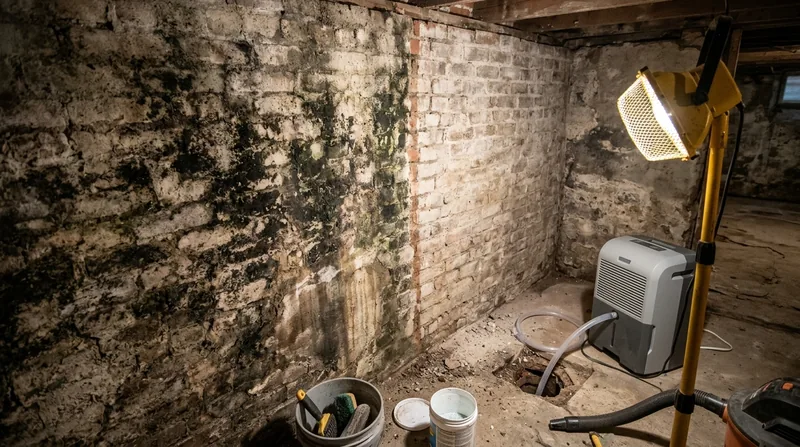




Basement Mold Remediation in Washington: Fix the Moisture, Not Just the Mold
Washington sits right on the fall line, where Piedmont schist and clay meet the Atlantic Coastal Plain, and that geology drives everything we see in basements here. The 1880s to 1920s brick rowhouses in Capitol Hill, Georgetown, Petworth and Bloomingdale sit on old brick or rubble-stone foundations with English basements that sweat through every humid summer. Basement Mold Remediation in Washington only works when you treat the mold and kill the moisture source feeding it. We handle both: containment and treatment of affected surfaces, then the drainage, sealing or dehumidification that keeps it from coming back. If you have a musty smell and no visible water, we run a moisture diagnostic before recommending anything. Start with a free basement inspection and we will tell you plainly what is wet and why.
Why Basement Mold Grows So Fast in Washington's Old Brick and Clay Soil
The District's heavy clay soil holds water against foundation walls long after a storm passes, and the water table in low spots along the Potomac, Anacostia and Rock Creek stays high through the summer. Add hazy, humid July and August air and a 100-year-old rubble-stone foundation in Brookland or Columbia Heights becomes a moisture trap. Flash flooding has repeatedly hit Bloomingdale and LeDroit Park, pushing water through footing drains and up through floor slabs.
- Hydrostatic pressure pushes water through mortar joints and hairline cracks, wetting the wall face where mold colonizes.
- Efflorescence (the white salt bloom on brick) signals active water movement through the masonry, not just surface dampness.
- Failed footing drains in pre-war homes let groundwater pool at the base of the wall instead of carrying it away.
- Sump pump failure during a summer downpour floods a finished basement in Bethesda or Bowie within hours.
- Grading and downspout extension problems send roof water straight back to the foundation on hillside lots in Arlington and Takoma Park.
Every one of those conditions feeds mold growth, and none of them go away because you wiped the wall with bleach.
Key info: A 1912 rowhouse in Bloomingdale with a rubble-stone foundation and a musty English basement is a classic case. The mold on the back wall was the symptom; the failed footing drain and a downspout dumping at the corner were the cause. Treating the wall without fixing the drain buys you one season.
For official guidance on mold and moisture in homes, the EPA's mold resource page is a solid starting point.
How We Run Basement Mold Remediation in Washington, Step by Step
We do not spray and walk away. The job starts with finding the moisture source, because remediation without moisture control is wasted money. On a 1940s Colonial in Cleveland Park or a 1960s split-level in Hyattsville, that often means checking the interior perimeter drain, the sump basin and the wall face after a rain event. We set up containment, remove or treat affected materials, then correct the water path.
- We inspect the basement and foundation, map wet zones, and test for active moisture with a meter.
- We set up containment with plastic sheeting and negative air pressure so spores do not spread to the rest of the house.
- We remove porous materials that cannot be cleaned (drywall, insulation, wood studs) and bag them for disposal.
- We treat structural surfaces with an antimicrobial and HEPA-vacuum the entire area.
- We correct the moisture source: sealing wall seepage, repairing the drain tile, replacing a failed sump pump, or extending downspouts.
- We install or verify a vapor barrier and recommend a dehumidifier sized for the space.
- We do a final moisture check and give you a written summary of what was done and what to watch.
If the diagnosis points to wall seepage rather than bulk water, basement wall sealing is often the right fix and far cheaper than excavation.
Key info: A 1950s brick ranch in Wheaton had mold along the bottom two feet of a finished wall. The cause was a clogged interior drain tile that let the sump basin overflow. We remediated the wall, cleared and repaired the drain, and replaced the pump. No exterior digging was needed.
Remediation Approaches We Use and When Each One Fits
The right method depends on what is growing, where it is growing, and what is feeding it. Here is how we match the approach to the condition.
| Approach | Description | Best for |
|---|---|---|
| Surface treatment and HEPA cleaning | Antimicrobial application plus HEPA vacuuming of joists, walls and slab. | Light surface mold on masonry and framing with a known, correctable moisture source. |
| Containment and material removal | Sealed work zone, negative air, removal of porous materials that cannot be saved. | Finished basements with mold behind drywall or under carpet after a flood or pump failure. |
| Drainage correction | Interior perimeter drain, drain tile repair, sump pump replacement or discharge line fixes. | Recurring mold where hydrostatic pressure or a failed drain keeps the slab and wall wet. |
| Moisture control and prevention | Vapor barrier, wall sealing, dehumidification, grading and downspout correction. | Humid summer condensation and musty smell with no standing water. |
We tell you which row applies to your basement after we see it, not before.
Basement Mold Remediation Cost in Washington: What to Expect
Most basement mold remediation jobs in the District start around $1,500, and that figure covers a defined area of surface mold with a straightforward moisture fix. Real jobs climb from there based on square footage affected, whether finished materials have to come out, and how much drainage correction is needed. A small musty corner in a Petworth cellar is a different job than a fully finished walkout in Bowie that flooded after a sump pump failure.
- Area affected drives labor and disposal most directly; a full wall costs more than a corner.
- Containment complexity rises when the basement is finished and occupied.
- Moisture source repair is the variable homeowners underestimate: a drain tile repair or sump replacement adds to the total.
- Access matters in tight English basements and rowhouse cellars where equipment barely fits.
Get two or three estimates and ask each one what moisture source they found and how they plan to correct it. A quote that only covers spraying is not a remediation plan. Our pricing overview breaks down the ranges in more detail.
Basement Mold Remediation Near Me: How to Vet a Contractor Near Washington
Mold remediation and waterproofing attract plenty of operators who spray first and diagnose never. When you search for basement mold remediation near me around Washington, use the same checklist you would for any trade working inside your home. Ask for the license and insurance certificate, and confirm the coverage is current, not just that it exists.
- Confirm the company is licensed and insured and ask for the certificate before work starts.
- Get at least two or three written estimates and compare what each one includes, not just the bottom line.
- Ask for references from jobs in your neighborhood or a similar house type, and call them.
- Ask whether permits are needed: structural foundation repair, egress work and drainage changes that touch the sanitary connection often require them, and rules vary by jurisdiction, so verify with the local building department.
- Get the warranty terms in writing and confirm whether it is transferable.
If a contractor cannot explain the moisture source in plain terms, keep looking. You can contact us for a straight answer and a free estimate.
Basement Mold Remediation in Washington: Pricing Guide
| Service | Price | Details |
|---|---|---|
| Surface mold treatment | Starting at $1,500 | Covers containment, antimicrobial treatment and HEPA cleaning for a defined area with a correctable moisture source. |
| Finished basement remediation | Starting at $2,800 | Includes removal of affected drywall and insulation, containment and disposal; scope of finished materials moves the price. |
| Remediation plus drainage correction | On estimate | When the mold traces to a failed drain tile, sump pump or wall seepage, we scope the water fix on site first. |
| Musty smell diagnostic | Included | Moisture mapping and source identification included with any remediation estimate, no separate diagnostic fee. |
| Travel | Included | In Washington and surrounding areas, no separate call-out or mileage fee. |
| Estimate | Free | Response within 24h at (771) 240-2593, no obligation to book. |
Indicative pricing, the exact cost depends on square footage, finish, and site access. Free personalized estimate within 24h at (771) 240-2593.


