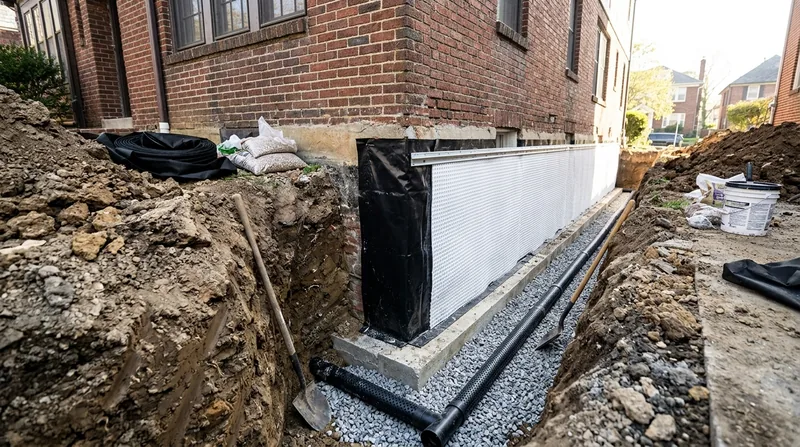




Washington sits right on the fall line where Piedmont schist and clay meet the Atlantic Coastal Plain, and that geology shows up in every basement from Georgetown to Brookland. Heavy clay soil holds water against old brick and rubble-stone foundations, buried streams and springs push the water table up in low spots along the Potomac, Anacostia and Rock Creek, and flash flooding has hit Bloomingdale and LeDroit Park repeatedly. When we talk about Exterior Basement Waterproofing in Washington, we mean digging down to the footing, sealing the wall where the water actually enters, and fixing the grading and downspouts that send stormwater back against the house. It is the most thorough fix for walls that seep after summer downpours and remnant tropical storms, and it is done once. If you want the full picture of how exterior work fits with the rest of our basement waterproofing services in Washington, start there.
Why Exterior Waterproofing Matters on Washington's Clay and Old Brick Foundations
The failure mode that dominates here is hydrostatic pressure against below-grade walls after heavy rain. In Capitol Hill and Petworth, 1880s-1920s rowhouses have English basements and full cellars on old brick footings that were never waterproofed. In Cleveland Park and Takoma Park, 1920s-1940s Tudors and Colonials sit on deep basements cut into hillsides, so runoff from uphill lots loads the downhill wall. In Bowie and Fairfax, 1980s-2010s subdivision homes have poured walkout basements where the original damp-proofing has aged out.
- Heavy clay and glacial clay soil trap water against the foundation instead of letting it drain away.
- Freeze-thaw winters open hairline cracks that seep every spring.
- Buried streams and springs in Bloomingdale and LeDroit Park raise the water table after storms.
- Original footing drains from the 1920s are often collapsed, root-filled, or simply gone.
When a wall is damp, efflorescence is blooming, or water shows after every storm, exterior work addresses the source instead of the symptom.
Key info: A Georgetown rowhouse on a rubble-stone foundation and a 1990s Bowie walkout need different answers. On the rowhouse, parging and a dimple board over a repaired wall is often the right call. On the walkout, correcting grade and extending downspouts may solve most of it before any excavation.
Permits for work that alters drainage or the sanitary connection of a sump discharge vary by jurisdiction, so confirm requirements with the local building department before work starts. DC's Department of Buildings publishes permit guidance at dob.dc.gov.
How We Do Exterior Basement Waterproofing in Washington, Step by Step
We start with a free basement inspection, because the right scope depends on what the wall is actually doing. A wall that seeps at one crack gets epoxy or polyurethane injection, not a backhoe. A wall that weeps across its length after every storm, or shows a high water line, is telling you the problem is hydrostatic pressure and the exterior is the honest answer. When exterior work is warranted, here is the sequence we follow.
- We locate utilities and the footing, then excavate down to the base of the wall by hand or machine depending on access.
- We clean and parge the wall, then repair any cracked or spalled mortar before anything goes over it.
- We apply a waterproof membrane directly to the foundation wall and cover it with dimple board to protect it and create a drainage plane.
- We install or replace footing drain tile at the base and tie it to a sump basin where the grade allows.
- We backfill with free-draining gravel, regrade the soil to slope away, and extend downspouts well clear of the foundation.
Every step is documented, and we walk you through the wall before we backfill so you can see what was done.
Local example: On a 1920s brick Colonial in Cleveland Park, the downhill wall seeped after every August storm. We excavated to the footing, repaired the mortar joints, applied membrane and dimple board, replaced a collapsed clay-tile footing drain, and regraded the side yard. Two seasons later the wall is dry. For hillside lots where surface water is the main driver, a French drain installation in Washington is often the better first move.
Exterior Waterproofing Approaches We Use
| Approach | Description | Best for |
|---|---|---|
| Full exterior excavation | Dig to the footing, repair the wall, apply membrane and dimple board, replace footing drain, regrade. | Walls that weep across their length after storms and show a high water line. |
| Exterior membrane and dimple board only | Seal and protect the wall where the footing drain is still functioning. | 1920s-1940s brick homes with a sound drain and localized seepage. |
| Grading and downspout correction | Reslope soil away from the wall and extend downspouts clear of the foundation. | Walkout basements and homes where surface water is the main driver. |
| Crack injection (epoxy or polyurethane) | Seal individual cracks from the inside where the wall is otherwise sound. | Isolated cracks with no evidence of broad hydrostatic pressure. |
| Interior drain tile and sump | Interior perimeter drain and sump basin to manage water from inside. | Cases where exterior excavation is impractical, such as shared rowhouse walls. |
Exterior Basement Waterproofing Cost in Washington: What to Expect
Exterior work is priced by the linear foot of wall, and in this market that starts at From $95/linear ft for a straightforward excavation with membrane and dimple board. That figure is a starting point, not a quote. Access is the biggest variable: a rowhouse in Columbia Heights with a shared wall and no side yard takes more labor than a detached Colonial in Bethesda with a clear excavation path. Depth of footing, whether the footing drain needs replacement, and how much soil has to be hauled away all move the number. For a full breakdown of how we price, see our waterproofing pricing page.
We always recommend getting two or three estimates on a job this size. Compare scope, not just the bottom line: ask whether the price includes footing drain replacement, dimple board, backfill gravel, and regrading, because a low bid that skips those items is not the same job.
Exterior Basement Waterproofing Near Me: How to Vet a Washington Contractror
Finding a waterproofing contractor near Washington who actually does exterior work is harder than it sounds, because many general foundation firms and plumbers advertise the service without the excavation experience. Ask direct questions and expect direct answers.
- Confirm the company is licensed and insured, and ask for a certificate of insurance before work begins.
- Get at least two or three written estimates that itemize membrane, drain tile, backfill, and regrading.
- Ask for references from jobs in your neighborhood and, where possible, visit a completed site.
- Confirm who pulls any required permit and check with the local building department on drainage and sump discharge rules.
- Ask how they protect landscaping, walkways, and neighboring properties during excavation.
A contractor who explains when simple crack sealing is enough and when the real problem is hydrostatic pressure is the one worth hiring.
Ready to get a straight answer on your wall? Contact Washington Waterproofing for a free basement inspection at (771) 240-2593.
Exterior Basement Waterproofing in Washington: Pricing Guide
| Service | Price | Details |
|---|---|---|
| Exterior excavation with membrane and dimple board | Starting at $95/linear ft | Includes excavation to footing, wall repair, membrane, dimple board, and backfill; access and depth move the price. |
| Exterior waterproofing with footing drain replacement | Starting at $135/linear ft | Adds new footing drain tile at the base and tie-in to sump basin where grade allows. |
| Grading and downspout correction only | Starting at $1,800 | Reslope soil away from wall and extend downspouts; priced by run length and haul-off. |
| Crack injection (epoxy or polyurethane) | Starting at $450 per crack | Includes injection ports, resin, and cleanup; price rises with crack length and wall thickness. |
| Complex or large-scale exterior job | On estimate | Shared rowhouse walls, deep footings, or tight access need an on-site look before a number is given. |
| Estimate | Free | Free basement inspection and written estimate, response within 24h at (771) 240-2593, no obligation. |
Indicative pricing, the exact cost depends on square footage, finish, and site access. Free personalized estimate within 24h at (771) 240-2593.


