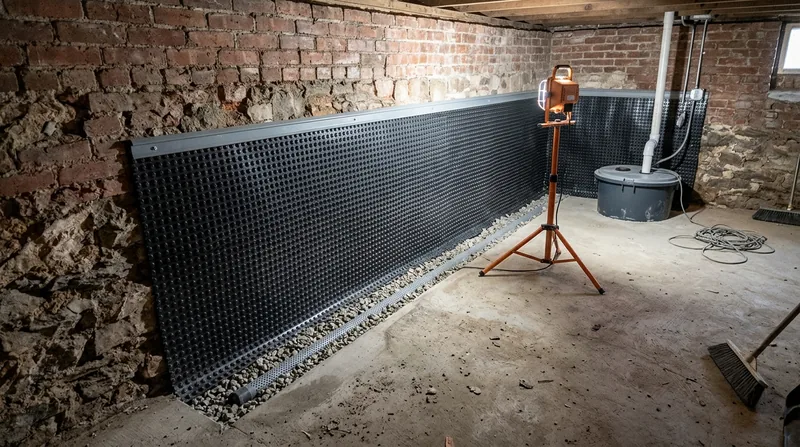




Basement Waterproofing in Washington: Built for Brick Rowhouses and Heavy Clay
When you need Basement Waterproofing in Washington, the fix depends on what the ground under your block is actually doing. This city sits on the fall line where Piedmont schist and clay meet the Atlantic Coastal Plain, so a Capitol Hill English basement on rubble stone and a Bowie walkout on poured concrete fail for completely different reasons. We trace the real water path first: buried streams, hillside runoff, hydrostatic pressure against old brick, or a footing drain that stopped working decades ago. Then we build a system sized for that house, not a package dropped on every job.
Heavy summer downpours, remnant tropical storms, and freeze-thaw winters keep the water table moving in low spots along the Potomac, the Anacostia, and Rock Creek. Bloomingdale and LeDroit Park have taken repeated flash flooding, and downhill walls in Cleveland Park and Takoma Park catch runoff from the slope above. Start with a free basement inspection so we can see where the water enters before anyone quotes a number.
Why Washington Basements Leak: Old Brick, Glacial Clay, and High Groundwater
Most of the housing stock here was never built to keep water out. The 1880s to 1920s rowhouses in Petworth, Columbia Heights, and Brookland sit on brick or rubble-stone foundations with no modern membrane and no working drain tile. In Bethesda, Wheaton, and Hyattsville, the 1950s and 1960s ranches have partly finished basements where the original footing drain is now clogged with clay fines. Newer subdivision walkouts in Fairfax and Reston deal with hydrostatic pressure from high groundwater after a storm. The dominant failure mode in this city is wall seepage and floor seepage driven by saturated glacial clay soil, not a single crack you can just patch.
- Water pushes through porous brick and mortar joints after days of rain, leaving efflorescence and a musty basement smell.
- Floor cracks and the cove joint weep when the water table rises under the slab.
- Runoff against rowhouse party walls and downhill walls overloads grading and downspout extensions that were never long enough.
- Old footing drains and weeping tile collapse or silt up, so water has nowhere to go but in.
Each of these calls for a different repair, and guessing wrong means paying twice.
Key info: In Bloomingdale and LeDroit Park, storm surge overwhelms the combined sewer and water backs up through floor drains. That is a different problem from wall seepage, and it needs a backwater valve discussion with your plumber before we install drain tile.
For the official word on what your jurisdiction requires, check the DC Department of Buildings before scheduling structural or drainage work.
How We Waterproof a Washington Basement, Step by Step
We work from the water source outward, and we tell you plainly when a simple crack seal is enough and when the real culprit is hydrostatic pressure that only an interior drain tile system will solve. Exterior excavation is the right answer on some downhill walls, but on a Capitol Hill rowhouse with a shared party wall it is often impractical, and an interior perimeter drain gets the same result with less disruption. Here is the sequence we follow on a typical Washington job.
- We inspect the basement, the exterior grading, the downspouts, and the foundation walls, and we map every entry point.
- We identify the water path: buried spring, hillside runoff, high water table, or failing footing drain.
- We recommend the system, whether that is interior drain tile, exterior membrane and dimple board, or injection for a specific crack.
- We cut and install the interior perimeter drain into a sump basin with a check valve on the discharge line.
- We seal wall seepage and install a vapor barrier where the wall is damp and musty.
- We test the sump pump and confirm the discharge line carries water away from the foundation.
Every job ends with a wet test, not a handshake.
Key info: On a 1920s Tudor in Cleveland Park, we found the downspouts dumping directly against the foundation and a footing drain packed solid with clay. Extending the downspouts and installing interior drain tile solved a wet basement the owner had lived with for years.
If your walls are bowing rather than seeping, that is a structural repair, and you should look at bowing wall repair before waterproofing.
Waterproofing Methods We Use and When Each One Fits
No single method fits every Washington basement. The table below shows how we match the approach to the failure we find on site.
| Approach | Description | Best for |
|---|---|---|
| Interior drain tile | Perimeter drain cut into the slab and routed to a sump basin | Hydrostatic pressure and floor seepage in rowhouses and ranches |
| Exterior waterproofing | Membrane, dimple board, and footing drain on the outside of the wall | Downhill walls with room to excavate in Arlington and Takoma Park |
| Crack injection | Epoxy or polyurethane injection through ports into a poured wall crack | A single settling crack in a 1960s Bethesda or Wheaton basement |
| Wall sealing and vapor barrier | Parging, waterproof membrane, and vapor barrier on damp walls | Seepage and musty smell in brick and block walls |
| Sump pump and battery backup | Sump basin, primary pump, check valve, and battery backup pump | Any system that must keep running through a storm-driven power outage |
Basement Waterproofing Cost in Washington: What to Expect
Pricing starts at $2,500 for a focused repair such as crack injection or a limited wall sealing job. A full interior drain tile system with a sump pump typically lands higher because it involves cutting the slab, running the perimeter, and setting the basin. Exterior excavation is usually the most expensive route, and on a rowhouse with a shared wall it may not be practical at all. The honest number depends on the size of the basement, the foundation material, access, and how many entry points we find.
- Foundation type drives the method: rubble stone in Georgetown costs more to work than poured concrete in Bowie.
- Access matters: a basement reached only through the house takes longer than one with an exterior entry.
- Water source matters: a single crack is a small job, while a high water table under the slab needs a full system.
- Pump and backup choices change the total, especially when you add a battery backup sump pump.
Get two or three estimates and compare the scope, not just the number. The full pricing overview breaks down what each approach includes.
Hiring a Basement Waterproofing Contractor Near Me in Washington
You want a specialist who does below-grade work every day, not a general handyman who will patch a crack and disappear. Ask for proof of licensing and insurance, and ask for references from jobs in your neighborhood. Confirm who pulls the permit when structural repair, egress work, or a change to the sump discharge connection is involved, because rules vary by jurisdiction and the local building department has the final word. If you are in a historic district or an HOA, check those requirements before work starts.
Get at least two or three written estimates and make sure each one names the method and the scope. A contractor who will not explain why they chose interior drain tile over exterior excavation is not the one to hire. When you are ready, contact us for a free estimate and we will walk the basement with you.
Basement Waterproofing in Washington: Pricing Guide
| Service | Price | Details |
|---|---|---|
| Crack injection (epoxy or polyurethane) | Starting at $2,500 | Includes port installation and injection of a single poured-wall crack, with access and crack length as the main cost factors. |
| Interior drain tile system | Starting at $4,500 | Includes perimeter drain, sump basin, and primary pump; basement size and slab access move the price. |
| Exterior basement waterproofing | Starting at $7,500 | Includes excavation, membrane, dimple board, and footing drain; depth and access to the wall drive the total. |
| Sump pump replacement with battery backup | Starting at $1,200 | Includes new primary pump, check valve, and battery backup unit; discharge line routing may add cost. |
| Complex or large-scale job | On estimate | Rubble-stone foundations, shared party walls, and multiple entry points need an on-site look before a number is given. |
| Estimate | Free | Response within 24h at (771) 240-2593, no obligation to book. |
Indicative pricing, the exact cost depends on square footage, finish, and site access. Free personalized estimate within 24h at (771) 240-2593.


