



Drain Tile Repair & Replacement in Washington: When the Footing Drain Is the Problem
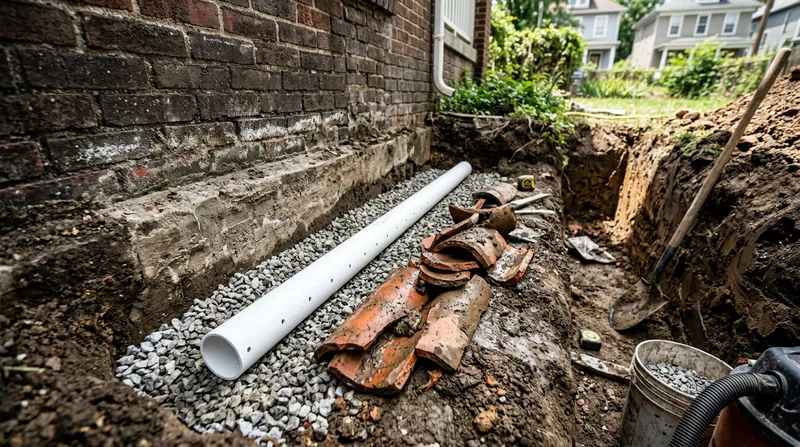
When you need Drain Tile Repair & Replacement in Washington, the failure is almost always underground and decades old. This city sits on the fall line where Piedmont schist meets Atlantic Coastal Plain clay, and the housing stock tells the story: 1880s to 1920s brick rowhouses with English basements in Capitol Hill, Georgetown and Bloomingdale, 1920s to 1940s Tudors and Colonials with deep cellars in Cleveland Park and Takoma Park, and 1950s to 1960s brick ranches across Bethesda and Hyattsville. Many of those homes still run on original clay tile footing drains that collapsed, silted up or got choked by roots long before anyone alive today bought the house. Water has nowhere to go, so it sits against the footing and pushes through the wall. We camera the line, find the break, and replace the failed section in modern PVC so the water leaves the foundation again. If the wet basement is broader than one drain line, start with our basement waterproofing service to see the full picture.
Why Old Footing Drains Fail in Washington's Clay and Fill Soils
Washington's heavy clay holds water instead of shedding it, and the low ground along the Potomac, the Anacostia and Rock Creek keeps the water table high through spring and after every summer downpour. Original clay tile was laid in short sections with open joints, and those joints are exactly where silt and roots get in. Once a run clogs or a tile shifts, the drain stops draining and the hydrostatic pressure against the footing does the rest. Bloomingdale and LeDroit Park have taken repeated flash flooding, and hillside blocks in Mount Rainier and Takoma Park send runoff straight into downhill walls.
- Original clay tile sections crack, shift and separate at the joints after decades of freeze-thaw cycles.
- Tree and shrub roots enter through open joints and gradually fill the pipe with a root mat.
- Glacial clay soil and fine silt wash into the line and settle into a solid plug.
- Buried streams and springs in low spots keep the drain under constant hydrostatic head.
- Downspouts and grading that dump water at the wall overload a drain that was already marginal.
Any one of these is enough to turn a footing drain into a wet basement, and most Washington homes we open up have two or three working at once.
Key info: A 1920s rowhouse in Petworth with a full cellar and a rubble-stone foundation is a very different drain tile job than a 1990s walkout in Bowie with poured walls and a sump basin already in place. We scope each one on site, because the failure mode in the older stock is usually collapsed clay tile, not a blocked outlet.
For the code side of drainage and discharge work, the DC Department of Buildings is the authority to check before any alteration to a drain or sump discharge connection.
How We Repair and Replace Drain Tile in Washington Homes
We start by proving the drain is actually the problem instead of guessing. A camera run down the line shows where the tile is collapsed, root-bound or silted, and where the outlet daylights or ties into the storm system. From there we choose between spot repair and full replacement, because a single failed section under a Capitol Hill side yard does not always justify digging the whole perimeter.
- We camera the existing line and mark the exact failure points and the outlet condition.
- We check the wall for efflorescence, seepage height and signs of hydrostatic pressure before we dig.
- We excavate the failed run to the footing, keeping the trench tight to protect nearby plantings and hardscape.
- We remove the collapsed clay tile and set new perforated PVC on a washed gravel bed with the correct fall.
- We tie the new run into the sump basin or discharge point and test flow before backfilling.
- We restore grading and downspout extensions so surface water stops reloading the drain.
If the camera shows the drain is sound but the wall still seeps, the answer is usually an interior system rather than more digging, and we say so plainly. See our interior drain tile system for that route.
Key info: On a 1930s brick Colonial in Silver Spring, we found the original clay tile crushed under a rear patio slab with the outlet buried in silt. We replaced roughly 40 feet of run in PVC, reconnected it to the sump basin, and the wall seepage stopped because the water finally had a path out. No interior system was needed on that house.
Repair Options: Matching the Method to the Failure
Not every drain tile problem needs the same fix, and the right call depends on where the failure sits, how deep the footing is and what is above the run. Here is how we sort the common approaches on Washington properties.
| Approach | Description | Best for |
|---|---|---|
| Targeted spot repair | We excavate and replace one failed section of tile and leave sound run in place. | A single collapse or root intrusion on an otherwise flowing line. |
| Full exterior run replacement | New perforated PVC on gravel along the footing, tied to the discharge point. | Long runs of collapsed clay tile on 1920s to 1960s foundations. |
| Interior perimeter drain | A drain cut inside the footing that collects water and sends it to the sump basin. | Walls that seep under hydrostatic pressure when exterior digging is impractical. |
| Outlet and discharge repair | Clearing or rerouting a buried, silted or blocked drain outlet. | Lines that are intact but never daylight or back up at the sump basin. |
| Drain plus wall sealing | Drain repair paired with crack injection and wall sealing where seepage has already started. | Older brick and rubble-stone walls with visible efflorescence and damp patches. |
We pick the lightest method that actually solves the water problem, and we tell you when a cheaper fix is enough.
Drain Tile Repair & Replacement Cost in Washington: What to Expect
Most drain tile work in this market starts around $750 for a targeted repair, and a full perimeter replacement on an older rowhouse or Colonial runs well above that. The number moves with the length of failed run, how deep the footing sits, and what we have to get through to reach it: a patio slab in Silver Spring, a mature garden in Cleveland Park, or a tight side yard in Georgetown all cost more to open than an empty lawn. Access is usually the single biggest line item on these jobs.
Foundation type matters too. Rubble-stone and old brick footings in Capitol Hill and Brookland need more careful excavation than poured walls in Bowie or Fairfax, and a drain that ties into a sump basin may need pump work at the same time. Get two or three written estimates and compare what is actually being replaced, not just the total. Our full pricing overview lays out the ranges in detail.
Finding a Drain Tile Repair & Replacement Contractor Near Me in Washington
Drain tile work is invisible until it fails, so the contractor you hire matters more than the pipe itself. Ask for proof of licensing and insurance, get at least three estimates in writing, and call references from jobs in your part of the city. Confirm who pulls the permit where drainage or sump discharge connections are altered, since the rules vary by jurisdiction and the local building department has the final say.
Ask how they diagnose the line. A crew that quotes a full replacement without camera footage is guessing, and a crew that only sells interior systems will not tell you when a simple exterior repair is the right answer. We are a dedicated basement waterproofing specialist, not a general foundation firm or a plumber, so the scope stays below grade. Reach out through our contact page to set up a free basement inspection and get the camera on the line.
Drain Tile Repair & Replacement in Washington: Pricing Guide
| Service | Price | Details |
|---|---|---|
| Targeted drain tile spot repair | Starting at $750 | Camera inspection plus replacement of one failed section, priced by depth and access difficulty |
| Partial run replacement | Starting at $1,850 | New PVC on gravel over a failed stretch, tied back into the existing outlet or sump basin |
| Full perimeter drain replacement | On estimate | Length of run, footing depth and what sits above the line drive the final number |
| Outlet and discharge repair | Starting at $650 | Clearing or rerouting a buried or silted outlet so the existing line can drain again |
| Travel | Included | In Washington and surrounding areas, no separate call-out or mileage fee |
| Estimate | Free | Response within 24h at (771) 240-2593, no obligation to book |
Indicative pricing, the exact cost depends on square footage, finish, and site access. Free personalized estimate within 24h at (771) 240-2593.


